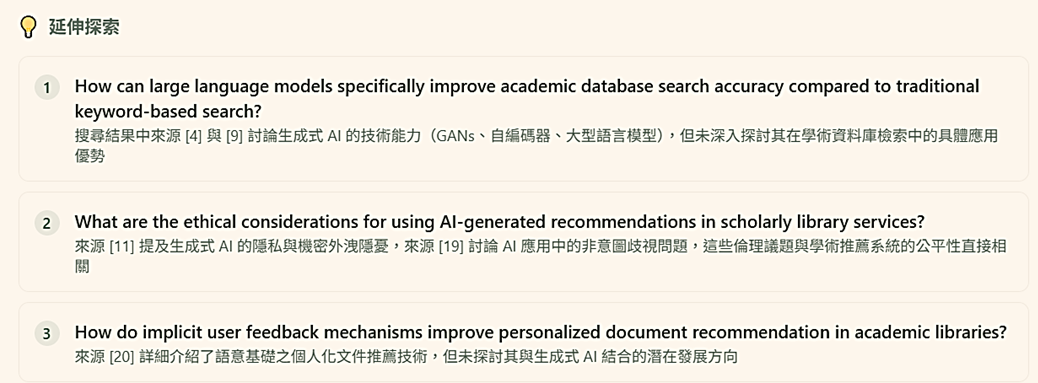
How Can Generative AI Improve Scholarly Search and Recommendation?
When asking Lumen this question, the most surprising part is often not the answer itself, but how it connects ideas across disciplines, decades, and languages to form an unexpected “knowledge diffusion map.” In a single search, Lumen may move from AI papers to philosophy, communication studies, library science, public governance, or even national security research—revealing how generative AI is reshaping the entire knowledge ecosystem.
Old Research Suddenly Regains Its Importance
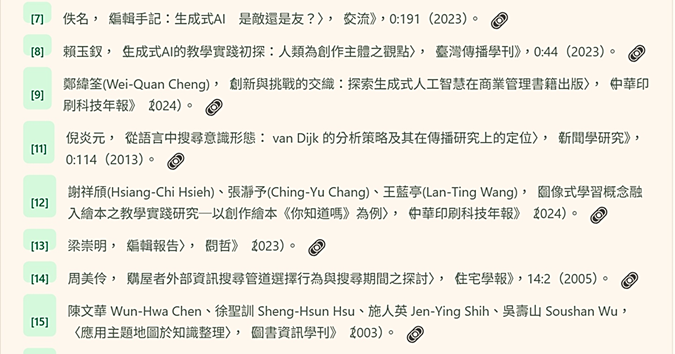
Lumen frequently uncovers overlooked studies from the early 2000s on knowledge organization, search behavior, recommendation systems, ontology, and PaperRank. Many concepts now central to AI—personalized recommendation, semantic retrieval, concept expansion, and user behavior analysis—were already being explored in library and information science two decades ago. Today, technologies such as RAG, vector search, and LLM retrieval are finally making these earlier visions practical.
AI Is Reshaping the Knowledge Production System
Lumen unexpectedly connected discussions on AI peer review, AI authorship, and academic ethics from journals originally focused on philosophy and humanities. This suggests that generative AI is no longer merely a technical issue—it is beginning to transform scholarly publishing, authorship, and the broader academic system itself.
Could Library and Information Science Be the Real Foundation of AI Search?
Lumen’s English responses frequently surface concepts such as semantic recommendation, ontology, metadata, implicit feedback, and recommendation systems. This reveals an important insight: the foundation of AI-powered scholarly search may lie not only in LLMs, but also in decades of research from information retrieval and library science.
Cross-Language Querying Opens Different Research Paths
Asking the same question in Chinese and English produces complementary research trajectories. Chinese queries tend to surface discussions on AI in academic writing, publishing, education, and media studies within the Chinese-speaking world. English queries more often lead into international research on semantic retrieval, conversational search, recommendation systems, ontology, and LLM retrieval. Lumen therefore does not simply “translate the same answer,” but enters different knowledge networks through different languages.
Unexpectedly Discovering Taiwan’s AI Perspective
Lumen also surfaces research from Taiwan’s national security and policy communities, including discussions on AI governance, information warfare, privacy leakage, and generative AI regulation. While global discussions often focus on OpenAI or Google, Lumen can guide researchers into highly localized yet globally significant knowledge domains rarely visible on the open web.
Beyond Answers: A “Knowledge Diffusion Map”
A single search may extend from recommendation systems and semantic retrieval to AI governance, information warfare, philosophy, and academic ethics. Lumen presents not only “which articles exist,” but how knowledge flows, expands, and reconnects across disciplines. This sense of a “knowledge diffusion map” may be what makes Lumen most distinctive.
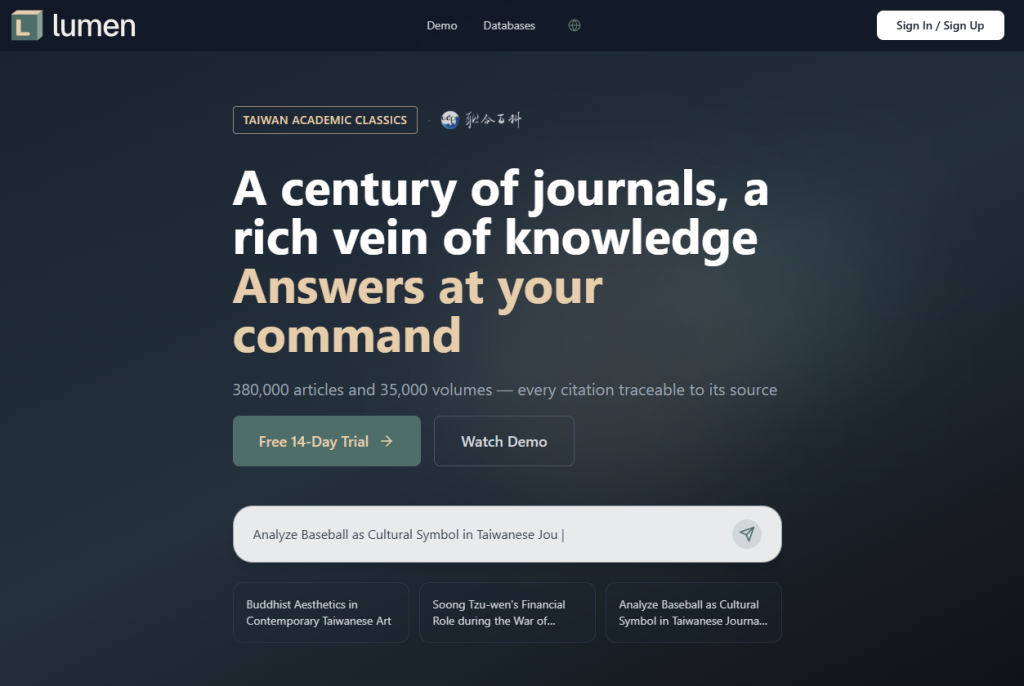
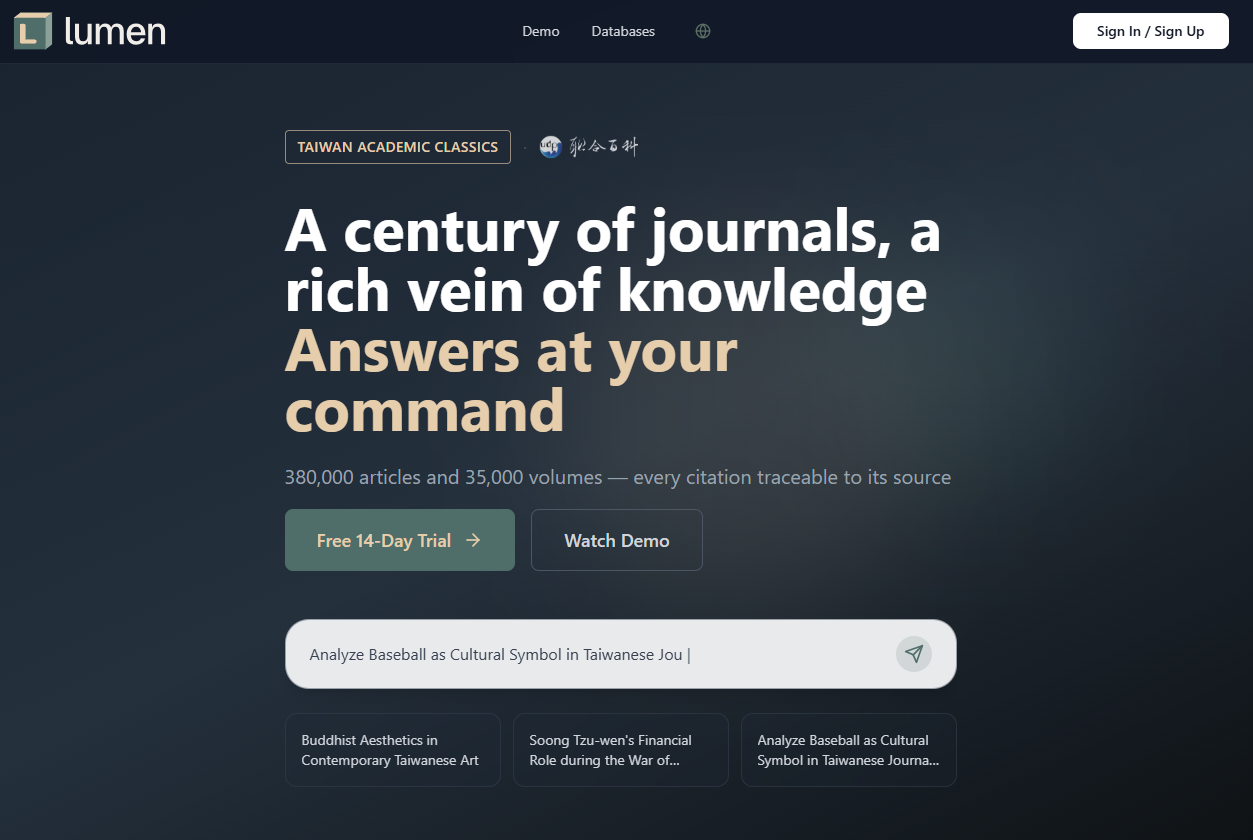
Lumenis an AI-powered research gateway designed for the humanities and social sciences, built upon United Digital Publications’ Taiwan Academic Classics (TAC) platform. Integrating cross-database full-text search, AI-assisted exploratory discovery, cross-language Chinese–English querying, and verifiable scholarly sources, Lumen helps researchers move beyond isolated answers toward broader research contexts and knowledge connections.
◆ Request a Trial
Explore new possibilities for AI-driven HSS research.
Build a faster, broader, and more connected environment for teaching and scholarship.
◆For inquiries:
TEL: +886-2-2365-5908
udp.kevin@gmail.com (Kevin Chang, Director)